
At Riverside House, we believe that rebuilding a life requires more than a second chance; it requires support, community, and access to essential resources. That’s why we are incredibly grateful for our partnership with the Miami Med Reentry Care Clinic (BRIDGE Clinic), a team of University of Miami medical students committed to bringing compassionate healthcare directly to individuals transitioning from incarceration.
During our recent Health Fair, the BRIDGE Clinic team provided free screenings, health guidance, and personal assistance to help our residents take an important step toward long-term wellness. Their work reflects a deep commitment to breaking barriers and restoring dignity, one relationship at a time.
We sat down with Stacey Li, a member of the BRIDGE Clinic team, to learn more about their mission and experience working with the reentry community here at Riverside House.
Q&A with Stacey Li — Miami Med Reentry Care Clinic (BRIDGE Clinic)
1. What inspired you and the Miami Med Reentry Care Clinic (BRIDGE Clinic) team to participate in Riverside House’s Health Fair and offer these free health screenings and community health resources?
The idea for the BRIDGE clinic with Miami Med Reentry Clinic originated with a prior patient who stayed at the Riverside House last year. Despite the services that he was receiving during his stay, his long history of incarceration and the accumulation of social barriers impeded him from appropriately receiving the healthcare that he needed, resulting in multiple admissions to the hospital. Unfortunately, his story is not unique. Individuals with justice involvement frequently face financial, systemic, and mistrust-related obstacles that prevent them from receiving adequate healthcare. As medical students, we have a responsibility to help bridge this gap. By meeting patients directly where they are, on-site at Riverside, we aim to confront these equities, start to rebuild trust, and provide care in a way that feels accessible and respectful. We also hope to expose more future physicians to this work and inspire them to consider service-oriented careers.
2. Miami Med Reentry Care Clinic (BRIDGE Clinic) focuses specifically on the reentry population, one of many vulnerable populations in Miami. Can you share why it’s important to include individuals in the re-entry process as part of this outreach?
The current organization of the American healthcare system has far too many cracks for the most vulnerable and marginalized to fall through. Reentry from incarceration is a crucial time for many individuals to rebuild their lives, re-integrate into society, reconnect with community, and ensure positive health outcomes. Yet, this population faces unique challenges, from legal restrictions to limited mobility and fragmented access to services. Targeted outreach and intentional engagement ensure that these specific needs are not overlooked.
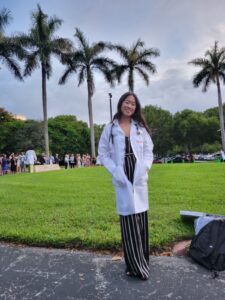
3. During the Health Fair, you and your team connected with residents who are rebuilding their lives. What stood out to you most about those interactions or moments of impact?
Working with marginalized patients can be challenging because of the numerous overlapping systems that have historically failed to provide adequate safety nets. Yet, despite these barriers, what consistently stands out to me when I speak to patients is their resilience. Many of the residents at the Riverside House found themselves in unfortunate circumstances and are in the process of rebuilding their lives. The tenacity of the patients we work with is an inspiration for us to continue advocating for equity and dignity in healthcare, working toward addressing health inequity.
4. How do you hope collaborations like this one with Riverside House will help shape the future of community-based healthcare for those transitioning back into society?
The population of re-entrants is unfortunately widely unrecognized and under-researched. Our collaborations with the Riverside House allow us to directly engage with this community, strengthen trust, and tailor healthcare delivery to what actually works on the ground. I am hopeful that partnerships like this will not only enhance continuity of care for individuals through the reentry process but also encourage more future physicians to pursue a community-based career focused on the underserved.
We are deeply appreciative of Stacey and the entire BRIDGE Clinic team for their heart, dedication, and willingness to show up for individuals too often overlooked by traditional healthcare systems.


